
Fallyneets english 4 Sections51 Lessons4 QuizzesLifetime
Social-Emotional Competencies
Social-emotional competencies are essential skills that allow individuals to interact effectively with others, understand emotions (their own and others’), and manage relationships in a healthy way.
For NEET youth, developing these competencies is particularly important, as they support confidence, communication, teamwork, and the ability to navigate social and professional environments.
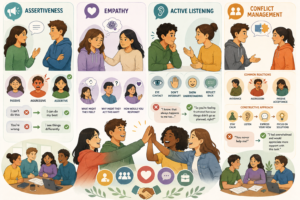
Assertiveness
What it is:
Assertiveness is the ability to express thoughts, feelings, and needs clearly and respectfully, without being passive or aggressive.
Why it matters:
Many young people either avoid expressing themselves (passive behaviour) or react with frustration (aggressive behaviour). Assertiveness helps find a balanced approach.
Example:
- Passive: “It’s fine, I don’t mind” (even if it’s not true)
- Aggressive: “This is wrong, you never listen!”
- Assertive: “I would like to share my opinion and be heard”
Practical exercise:
Ask learners to rewrite sentences:
- “I can’t do this” → __________________________
- “You’re wrong” → __________________________
Goal: transform into assertive communication.
Empathy
What it is:
Empathy is the ability to understand and share the feelings of another person.
Why it matters:
Empathy helps build trust, improve relationships, and reduce conflict. It also allows young people to better understand different perspectives.
Example:
A friend cancels plans at the last minute.
Instead of reacting with anger, empathy allows understanding that they may be dealing with personal difficulties.
Practical exercise:
Scenario reflection:
- What might this person be feeling?
- Why might they act this way?
- How would you respond empathetically?
Active Listening
What it is:
Active listening means fully focusing on the speaker, understanding their message, and responding thoughtfully.
Why it matters:
Many conflicts arise because people do not feel heard. Active listening improves communication and strengthens relationships.
Key elements:
- Maintain eye contact
- Avoid interrupting
- Show understanding (e.g., nodding, short responses)
- Reflect back what was said
Example:
Instead of:
“I know, that always happens to me too…”
Try:
“So you’re feeling frustrated because things didn’t go as planned, right?”
Practical exercise:
Pair activity:
- Person A speaks for 2 minutes about a challenge
- Person B listens without interrupting
- Person B summarises what they heard
Conflict Management
What it is:
Conflict management is the ability to handle disagreements in a constructive and respectful way.
Why it matters:
Conflict is part of everyday life. Learning how to manage it prevents escalation and supports problem-solving.
Common reactions to conflict:
- Avoidance
- Aggression
- Passive acceptance
Constructive approach:
- Stay calm
- Listen to the other person
- Express your point of view clearly
- Focus on solutions, not blame
Example:
Instead of saying:
“You never help me!”
Try:
“I feel overwhelmed and would appreciate more support with this task.”
Practical exercise:
Conflict role-play:
- Scenario: disagreement in a group project
- Learners practise expressing needs and finding a solution
Key reflection
Strong social-emotional skills improve not only relationships, but also employability.
Employers value communication, teamwork, and emotional intelligence as much as technical skills.
Key message
Understanding yourself helps you understand others.
And understanding others helps you build better opportunities.