
Fallyneets english 4 Sections51 Lessons4 QuizzesLifetime
Relevance for NEET Youth
Emotional resilience plays a critical role in the lives of young people who are not in education, employment, or training (NEET). This group often faces a combination of personal, social, and economic challenges that can significantly impact their emotional wellbeing and future opportunities.
Consequences of long-term stress, unemployment, and unstable environments
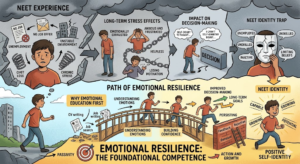
Many NEET youth experience prolonged periods of uncertainty. The absence of structured daily routines, financial instability, and limited access to opportunities can create chronic stress.
Over time, this can lead to:
● Emotional exhaustion
● Increased anxiety and frustration
● Feelings of helplessness
● Loss of motivation
Without the right coping strategies, this type of stress can become a barrier to taking action, trying new opportunities, or engaging in learning processes.
Impact on decision-making, self-confidence, and motivation
Emotional states strongly influence how decisions are made. When young people feel overwhelmed, insecure, or discouraged, they are more likely to:
● Avoid making decisions
● Doubt their abilities
● Give up easily when facing challenges
● Choose short-term comfort over long-term goals
Low self-confidence often leads to a cycle where individuals do not take action, which then reinforces their belief that they are not capable.
Motivation is also affected. When efforts do not seem to lead to results, it becomes harder to stay engaged or believe that change is possible.
The “NEET identity trap”
One of the most critical emotional challenges is the development of a negative self-identity.
The term “NEET identity trap” refers to a situation where young people start to define themselves based on their current status rather than their potential. Labels such as “unemployed,” “unskilled,” or “inactive” can become internalised and influence how individuals see themselves.
This can lead to:
● Limiting beliefs (“I am not capable”)
● Fear of trying new things
● Avoidance of opportunities
● Reduced self-worth
Over time, this identity can become a self-fulfilling cycle, where the individual’s perception prevents them from taking the steps needed to change their situation.
Why emotional education is essential before employability training
Before focusing on employability skills such as CV writing, job search strategies, or technical training, it is essential to address emotional readiness.
Without emotional resilience:
● Young people may not engage fully in training programmes
● They may struggle to handle rejection or feedback
● They may abandon opportunities at the first difficulty
Emotional education helps individuals:
● Understand and manage their emotions
● Build confidence and self-awareness
● Develop persistence and adaptability
● Reframe failure as part of the learning process
By strengthening emotional resilience first, NEET youth become more prepared to engage in learning, take risks, and pursue opportunities with a more positive and proactive mindset.
Key message
Emotional resilience is not an “extra” skill — it is a foundational competence. It enables young people to move from a state of passivity and uncertainty to one of action, growth, and self-development.