
Fallyneets english 4 Sections51 Lessons4 QuizzesLifetime
Pedagogical Approach to the AI Tools
The pedagogical use of AI tools in the FALLYNEETS project should always be guided by the principles of inclusion, simplicity, critical thinking, and learner autonomy. AI is not introduced as a substitute for teachers, peer interaction, effort, or reflection. Instead, it should be understood as a supportive layer within the Personal Learning Environment: a set of scaffolding tools that can help learners access information, organize ideas, simplify complex tasks, create initial outputs, and engage with content in ways that are more flexible and personalized.
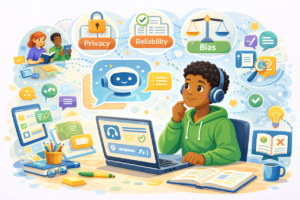
This pedagogical perspective is especially important when working with young NEETs, many of whom may have experienced discontinuity in education, low academic confidence, or negative previous experiences with formal learning. For these learners, AI can reduce the pressure associated with starting a task. A long text may feel more approachable if it can be summarized or explained in simpler language. An empty page may become less intimidating if AI helps generate an outline or a first draft. A confusing instruction may become manageable if the learner can ask for clarification, examples, or a step-by-step explanation. In this sense, AI can play an important role in lowering entry barriers and creating a more accessible point of engagement.
However, the educational value of AI does not lie only in efficiency or convenience. Its true value lies in how it can support learning processes without removing learner agency. AI should be used to help learners think, not to think in their place. It can provide prompts, explanations, examples, and feedback, but the learner should remain actively involved in making choices, checking meaning, interpreting results, and deciding what is useful. The pedagogical aim is not to encourage passive dependence on AI, but to strengthen the learner’s capacity to interact with support tools critically and purposefully.
For this reason, AI should be introduced in simple, guided, and meaningful ways. Learners should not be overwhelmed with technical explanations or encouraged to use AI for everything. Instead, they should be shown a small number of realistic use cases that respond to genuine needs. For example, AI can help simplify a difficult paragraph, generate possible questions for revision, organize the structure of a presentation, or provide
examples of how to begin a reflection. These limited but practical applications are often more educationally valuable than broad or unspecific experimentation, because they help learners understand what AI is actually for and how it can fit into their learning routine.
A core element of the pedagogical approach must be critical thinking. AI-generated content may sound fluent and convincing, but it is not always accurate, complete, neutral, or appropriate. Learners need to understand that AI outputs should not be accepted automatically. They should be encouraged to question responses, compare information with other sources, identify inconsistencies, and ask whether the output is clear, relevant, and reliable. This practice is essential not only for digital literacy, but also for building habits of reflection and verification in a context where AI-generated information is becoming increasingly common.
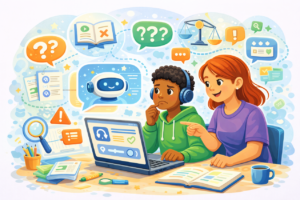
Reliability is therefore a major teaching point. Young people should learn that AI may generate mistakes, oversimplifications, invented facts, or biased interpretations. For NEET learners, who may already feel uncertain about their own judgment, it is particularly important that AI is not presented as an unquestionable authority. Instead, trainers should model how to treat AI as one source among others: useful for support, but always open to verification and discussion. In this way, AI becomes part of a broader learning process that values reasoning, comparison, and informed decision-making.
Privacy and responsible use are also central to the pedagogical approach. Learners need support in understanding that they should not enter sensitive personal information, private data, or confidential material into AI tools without clear guidance. They should also reflect on how AI systems use information, what digital footprints they may leave, and why responsible use matters. This is particularly relevant when working with vulnerable groups,
as safe digital habits are closely linked to autonomy, protection, and long-term participation in online environments.
Another key issue is bias. AI systems are not neutral, and the outputs they generate may reflect limitations or biases present in the data on which they were trained. For this reason, pedagogical use of AI should include opportunities to discuss representation, fairness, stereotypes, and point of view. Learners should be encouraged to notice when an output feels one-sided, culturally narrow, or socially problematic. This helps connect AI use with ethical awareness and strengthens the learner’s ability to engage with technology as a critical participant rather than as a passive user.
At the same time, AI can support personalization in valuable ways. Some learners may need simpler language, repeated explanations, or more examples before they feel ready to continue. Others may benefit from support in organizing ideas, planning a task, or checking whether they have understood correctly. AI can respond to these different needs quickly and flexibly, which makes it especially useful in diverse learning groups. When used well, it can complement the trainer’s work by providing immediate support while still leaving space for human guidance, discussion, and emotional encouragement.
From a pedagogical perspective, AI should therefore be embedded within a broader framework of support, not used in isolation. Trainers remain essential in helping learners interpret outputs, set limits, ask good questions, and reflect on what the AI is doing. Peer interaction also remains important, because discussion with others helps learners compare perspectives and avoid over-reliance on automated responses. The human dimension of learning is not replaced by AI; rather, AI should be positioned as one resource among many in a supportive and inclusive learning ecology.
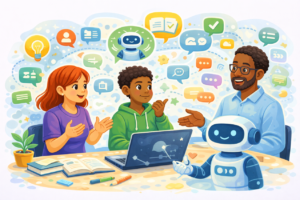
For young NEETs, this balanced approach is especially important because the goal is not only to complete tasks, but to build confidence, autonomy, and transferable digital competence. Learners should come to see AI as a practical tool that can help them begin, structure, and reflect, while also understanding that good learning still requires judgment, effort, and responsibility. In this way, AI contributes not to dependency, but to empowerment.
The pedagogical use of AI tools in FALLYNEETS should therefore aim to reduce barriers, support personalization, and strengthen learner engagement, while also promoting critical thinking, ethical awareness, and responsible use. Used in this way, AI becomes a meaningful support for learning: not a shortcut that replaces thinking, but a scaffold that helps learners participate more confidently, reflect more deeply, and progress more independently within their Personal Learning Environment.