
Creativity Tools
Creativity tools allow learners to transform ideas, knowledge, and personal experiences into visible and meaningful outputs such as posters, presentations, short videos, mind maps, digital stories, visual summaries, or simple portfolios. Within the FALLYNEETS project, these tools are especially important because they help learners move beyond passive consumption of information and become active creators of content. This shift is pedagogically significant: when learners create something of their own, they are not only using digital tools, but also interpreting information, making choices, expressing identity, and constructing meaning.
For young NEETs, creativity tools can be highly motivating because they support expression, experimentation, and ownership. Many learners may feel disconnected from traditional educational formats that rely heavily on long texts, formal writing, or abstract explanations. Creative digital tools offer alternative ways of engaging with content, making learning more accessible and more personally relevant. Through design, images, video, color, layout, and visual storytelling, learners can communicate ideas in ways that feel more natural, engaging, and achievable. This is particularly valuable for those who may struggle with confidence, literacy, or previous negative experiences in formal learning contexts.
These tools are also strongly connected to learner voice and identity. Creative production allows young people to represent their interests, goals, opinions, and experiences in a tangible form. A learner can design a motivational poster about future ambitions, prepare a visual presentation on employability skills, create a short video introducing personal strengths, or develop a mind map about their learning goals. In each case, the final product is not only a task outcome, but also an expression of self-awareness and personal perspective. This can strengthen engagement and help learners feel that their ideas have value.
Creativity tools are particularly useful in project-based learning, where learners are asked to explore a topic, process information, and produce a final result. In this context, creative tools help make learning more dynamic and visible. Instead of only reading or listening, learners can synthesize what they have understood by creating an infographic, a presentation, a storyboard, or a digital poster. This process supports deeper learning because it requires selecting relevant information, organizing it clearly, and presenting it in a form that others can understand. Creativity therefore becomes not only an artistic activity, but also a cognitive and communicative one.
Another important value of creativity tools lies in portfolio building. For many NEET learners, seeing evidence of progress is essential for rebuilding confidence and motivation. Creative outputs can become concrete artifacts that document learning over time. A collection of posters, presentations, visual reflections, or short digital projects can show
personal development, skill acquisition, and growing digital competence. These outputs can also be useful in employability pathways, as they help learners demonstrate initiative, communication skills, creativity, and practical engagement with digital tools.
From a pedagogical perspective, creativity tools also support reflection. When learners are asked to transform a topic into a visual or multimedia format, they must think carefully about what matters most, how ideas connect, and how a message can be communicated clearly. This encourages interpretation rather than repetition. For example, creating an infographic about healthy digital habits requires more than copying information; it involves selecting key points, deciding on structure, and making the content understandable to others. In this way, creative work strengthens both understanding and personal meaning-making.
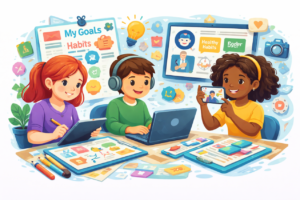
Creativity tools are especially helpful for multimodal learning. Not all learners process information in the same way, and some may understand and communicate more effectively through visual, spatial, or audiovisual formats than through text alone. By offering multiple ways to represent knowledge, creativity tools help make learning more inclusive. They can reduce the pressure associated with text-heavy tasks and provide learners with alternative routes to participation and success. This is particularly important in diverse learning groups where confidence, literacy levels, and communication preferences may vary significantly.
Examples of creativity tools include Canva, image generators, slide creation platforms, digital whiteboards, basic video editing applications, and mind mapping tools. These resources can be used for individual expression, collaborative activities, or project presentation. However, their value does not depend on complexity. In many cases, a simple poster, a one-slide visual summary, or a short digital collage can be more educationally meaningful than a highly polished but superficial product. For this reason, the pedagogical focus should remain on communication, reflection, and learner engagement rather than on technical perfection.
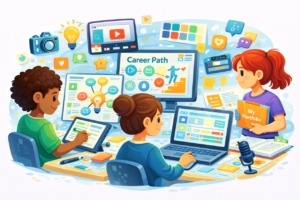
It is also important to guide the use of creativity tools with a clear educational purpose. Without support, learners may focus too much on decorative aspects and too little on content. Trainers should therefore help learners understand that visual appeal should serve clarity and communication, not distract from them. Clear instructions, realistic goals, and simple templates can help learners stay focused on meaning while still enjoying the creative process. Gradual introduction is also important, especially for those with low digital confidence, so that creativity becomes empowering rather than overwhelming.
The pedagogical value of creativity tools lies, therefore, in much more than producing attractive materials. They increase motivation, encourage active participation, support reflection, strengthen communication skills, and promote learner autonomy. They help young people see that they are not only capable of understanding information, but also of transforming it into something original and meaningful. Within the Personal Learning Environment, creativity tools contribute to a more engaging, expressive, and learner-
centered approach, supporting NEET youth in building confidence, visibility, and a stronger sense of ownership over their learning process.