
Emotional Resilience
Definitions from psychology and youth development literature
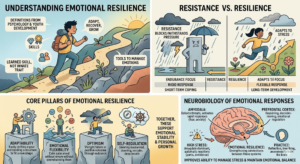
Emotional resilience refers to the ability to adapt, recover, and grow in response to stress, adversity, or challenging life situations. In psychology, it is often described as a dynamic process that enables individuals to maintain or regain emotional balance after experiencing difficulties.
From a youth development perspective, emotional resilience is not just about “bouncing back,” but also about developing the skills, attitudes, and behaviours needed to navigate uncertainty, build confidence, and sustain motivation over time.
Rather than being an innate trait, emotional resilience can be learned and strengthened through experience, reflection, and practice. This is especially important for young people who face unstable environments or limited opportunities, as it provides them with tools to manage emotions and make constructive decisions.
Difference between resilience and resistance
Although often used interchangeably, resilience and resistance are different concepts.
● Resistance refers to the ability to withstand pressure or avoid being affected by external stressors. It is more about “holding on” or blocking impact.
● Resilience, on the other hand, involves adaptation and transformation. It is the capacity to respond to challenges, learn from them, and continue moving forward.
A resistant person may try to ignore or suppress difficulties, while a resilient person acknowledges them, processes the emotional impact, and adjusts their response accordingly.
| Resistance | Resilience |
| Avoids or blocks stress | Adapts to stress |
| Focus on endurance | Focus on growth |
| Rigid response | Flexible response |
| Short-term coping | Long-term development |
Core pillars of emotional resilience
Emotional resilience is built on several key components that work together to support emotional stability and personal growth:
- Adaptability
The ability to adjust to new situations, changes, or unexpected challenges. Adaptable individuals can shift their perspective and behaviour when needed.
- Emotional flexibility
The capacity to experience, understand, and regulate a wide range of emotions without becoming overwhelmed. It involves recognising emotions without being controlled by them.
- Optimism
A realistic but positive outlook on life. Optimism does not mean ignoring difficulties, but believing that challenges can be overcome and that effort can lead to improvement.
- Self-regulation
The ability to manage emotional reactions, impulses, and stress responses. This includes calming oneself, delaying reactions, and choosing constructive behaviours.
Together, these pillars help individuals respond to difficulties in a balanced and proactive way.
The neurobiology of emotional responses (basic introduction)
Emotional resilience is closely linked to how the brain processes stress and emotions.
When a person faces a stressful situation, the brain activates a rapid response system often known as the “fight, flight, or freeze” response. This reaction is controlled by a part of the brain called the amygdala, which detects threats and triggers emotional responses such as fear or anxiety.
At the same time, another part of the brain—the prefrontal cortex—is responsible for reasoning, decision-making, and emotional regulation. When functioning effectively, it helps individuals pause, reflect, and choose how to respond rather than reacting impulsively.
In high-stress situations, the amygdala can become dominant, leading to automatic reactions such as panic, avoidance, or frustration. Emotional resilience involves strengthening the connection between these brain systems so that individuals can regulate their responses more effectively.
Through practices such as reflection, breathing techniques, and emotional awareness, it is possible to train the brain to respond in a calmer and more controlled way. Over time, this improves the ability to manage stress and maintain emotional balance.