Conceptual Framework
Auxiliary digital technological tools are supportive digital resources that help learners access, organize, understand, create, and share information more effectively. In the context of the FALLYNEETS project, these tools are not understood as isolated applications, but as practical enablers of learning autonomy, digital participation, and employability. Their main function is to reduce barriers that often prevent young NEETs from engaging in education, training, and self-directed development.
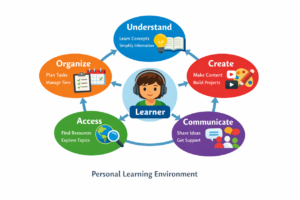
For young NEETs, technology can become a bridge between personal motivation and concrete action. When tools are intuitive and relevant to everyday needs, they help learners plan tasks, simplify difficult content, communicate with others, build confidence, and take gradual control over their own learning journeys. This shift from passive consumption to active participation is essential in a Personal Learning Environment (PLE), where the learner is encouraged to make choices, set goals, and reflect on progress.
Digital literacy is therefore a core 21st-century competence. It includes not only the ability to use devices and platforms, but also the capacity to search for information, evaluate reliability, communicate responsibly, manage digital identity, and use online tools in meaningful ways. For NEETs, digital literacy is closely linked to social inclusion and employability, because access to learning and work opportunities increasingly depends on digital confidence and critical use of technology.
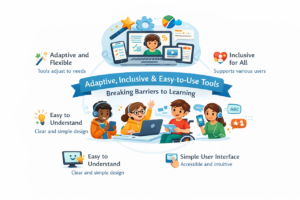
For this reason, the FALLYNEETS approach prioritizes adaptive, inclusive, and easy-to-use tools. Auxiliary tools should be accessible to learners with different levels of confidence, literacy, and digital experience. They should also support different learning styles, provide clear interfaces, and allow learners to progress step by step. In this sense, technology is not the goal itself; it is a means to empower young people to participate more actively in lifelong learning and to build realistic pathways toward employment and personal development.
For this reason, the FALLYNEETS approach prioritizes adaptive, inclusive, and easy-to-use tools. Auxiliary tools should be accessible to learners with different levels of confidence, literacy, and digital experience. They should also support different learning styles, provide clear interfaces, and allow learners to progress step by step. In this sense, technology is not the goal itself; it is a means to empower young people to participate more actively in lifelong learning and to build realistic pathways toward employment and personal development.
The importance of adaptive, inclusive, and easy-to-use tools is especially visible when working with young people who may have experienced educational disengagement, low self-esteem, interrupted learning paths, or negative past experiences with formal systems. If a digital tool is too complex, too text-heavy, or visually overwhelming, it can quickly become another barrier instead of a support. For this reason, tools should be designed or selected in a way that lowers entry barriers from the very beginning. Simple navigation, visual clarity, intuitive instructions, and a limited number of essential functions help learners focus on the task itself rather than on trying to understand the platform.
Adaptivity is also essential because learners do not all start from the same point. Some may need simplified language, others may benefit from visual guidance, audio support, repetition, or extra time to complete a task. An adaptive tool makes it possible to personalize the learning experience without stigmatizing the learner. It allows each young person to engage with content at an appropriate pace and according to their individual needs, which increases both participation and persistence.
Inclusiveness means more than providing access to a device or an internet connection. It means creating digital learning opportunities that are genuinely usable by people with different abilities, backgrounds, and preferences. Inclusive tools respect diversity in
literacy levels, language competence, cognitive styles, and motivation. They help ensure that learners are not excluded because content is too difficult to read, instructions are unclear, or the interface assumes prior digital competence that they may not yet have.
Easy-to-use tools are also important from a motivational perspective. When learners experience early success with a digital resource, they are more likely to continue exploring, experimenting, and developing autonomy. A positive first experience can strengthen confidence and reduce fear of failure. Over time, this contributes to a more empowering relationship with technology, where digital tools are seen not as sources of stress, but as practical companions for learning, communication, and self-development.
Finally, adaptive and inclusive tools support equity within the Personal Learning Environment. They make it possible for each learner to build a PLE that is functional, realistic, and personally meaningful. In this way, ease of use is not a minor technical detail, but a pedagogical condition for participation, autonomy, and long-term engagement in lifelong learning.