
Self-Learning & Assessment Tools
Self-learning and assessment tools support learners in understanding content at their own pace and checking whether they have understood it correctly. Within the FALLYNEETS project, these tools are especially relevant because many young NEETs have experienced discontinuity in education, low academic confidence, or negative learning experiences that make traditional forms of assessment feel intimidating or discouraging. For this reason,
learners often need more flexible, supportive, and personalized ways to revisit content, practise skills, and verify their progress without feeling judged or pressured.
One of the main strengths of self-learning and assessment tools is that they allow learners to work at a pace that matches their own needs. In conventional educational settings, learners may feel left behind if explanations move too quickly or if they are expected to demonstrate understanding before they feel ready. Digital self-learning tools can reduce this pressure by making it possible to pause, repeat, simplify, review, and practise content as many times as necessary. This creates a more supportive learning environment in which learners can build understanding gradually and with greater confidence.
For NEET youth, this flexibility is particularly important because learning pathways are often non-linear. Some learners may need to revisit basic concepts, while others may already have partial knowledge but require support in organizing or applying it. Self-learning tools help respond to these differences by offering adaptive and personalized pathways. Rather than assuming that all learners should engage with content in the same way, they make it possible to adjust explanations, examples, and activities according to individual starting points and levels of confidence.
AI-based support tools are especially useful in this category because they can explain concepts in simpler language, generate summaries, propose practice questions, adapt the complexity of tasks, or provide alternative examples. They can also help learners reformulate information, check their understanding, or identify areas where more practice is needed. Used pedagogically, these tools do not replace the trainer or the learning relationship; instead, they act as scaffolding that supports comprehension, confidence, and gradual independence. They help learners take the first step when a task feels too difficult and provide guidance that can make learning more approachable.
Another important pedagogical value of these tools lies in immediate feedback. Learners benefit greatly when they can test their understanding and receive a response without having to wait for formal evaluation. Short quizzes, guided questions, AI-generated practice tasks, self-check activities, and instant corrections can help learners identify misunderstandings early and adjust their approach. This kind of low-stakes assessment is especially useful for learners who fear failure, because it presents mistakes as part of the learning process rather than as proof of inability.
Self-learning and assessment tools also support metacognition, that is, the learner’s ability to reflect on how they learn, what they already understand, and where they still need support. When learners compare answers, review explanations, repeat tasks, or check their progress over time, they begin to develop greater awareness of their own learning strategies. This is particularly valuable in a Personal Learning Environment, where autonomy depends not only on using tools, but also on understanding how to regulate one’s own learning process.
These tools can also reduce anxiety around performance. Many NEET learners may hesitate to share unfinished work or answer questions in front of others because they are afraid of being wrong. Self-learning tools create a safer space for experimentation and preparation. Learners can practise privately, repeat exercises, request additional examples, and improve their responses before sharing them with trainers or peers. In this way, assessment becomes less threatening and more developmental, helping learners move from uncertainty to readiness.
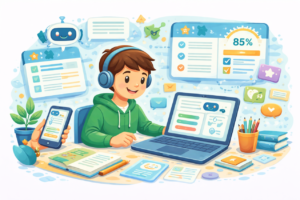
Examples of self-learning and assessment tools include AI assistants that simplify or adapt content, quiz platforms, self-check forms, flashcard apps, interactive exercises, and guided reflection tools. Their educational value does not depend only on technical sophistication, but on how effectively they help learners understand, practise, and monitor progress. In many cases, a simple tool that offers clear questions and immediate feedback can be more beneficial than a more advanced platform that feels confusing or impersonal.
From a pedagogical perspective, it is essential to use these tools with clear guidance and realistic expectations. Learners should understand that AI-generated explanations or feedback are supportive aids, not unquestionable truths. Trainers should encourage learners to compare information, ask critical questions, and reflect on whether a response is accurate, useful, and appropriate. This helps combine personalization with critical thinking, which is especially important when AI is
The educational value of self-learning and assessment tools therefore lies in their ability to personalize learning, reduce fear of failure, strengthen reflection, and support gradual progression from guided learning to self-directed learning. Within the Personal Learning Environment, they help learners become more active, aware, and confident participants in their own development. For young NEETs, these tools can provide an essential bridge between dependence on external support and the growing ability to learn, check understanding, and progress with greater autonomy.