
Accessibility Tools
Accessibility tools ensure that digital learning is usable, understandable, and meaningful for learners with different needs, abilities, and preferences. Within the FALLYNEETS project, these tools are especially important because inclusion in digital learning cannot be limited to simply providing access to a device or an internet connection. True access also means that learners can read, listen to, navigate, interpret, and interact with content in ways that match their individual capacities and learning preferences. In an inclusive Personal Learning Environment, accessibility therefore becomes a core pedagogical principle rather than an optional technical feature.
For young NEETs, accessibility is essential because the barriers they face are often diverse and interconnected. Some learners may experience low literacy levels, language difficulties, neurodiversity, visual fatigue, attention challenges, or low confidence when confronted with long written texts. Others may have had negative educational experiences that make text-heavy or rigid digital environments feel intimidating and exclusionary. When these barriers are not addressed, learners may disengage not because they lack interest or ability, but because the format of the content does not allow them to participate comfortably or effectively.
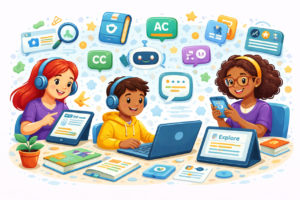
Accessibility tools help respond to these challenges by offering alternative ways of accessing and processing information. Text-to-speech tools, for example, allow learners to listen to written content while following the text visually, which can support comprehension, concentration, and reading stamina. Reading assistance extensions can simplify navigation, highlight key words, break down difficult passages, or provide vocabulary support. Dictionaries, translation tools, screen readers, captioning systems, and interface adjustments such as font size changes, contrast options, or distraction-free modes can all contribute to making digital learning environments more manageable and more inclusive.
These tools are valuable because they make content more approachable without reducing the learner’s dignity or potential. Instead of treating difficulty as failure, accessibility tools recognize that learners may need different entry points into the same material. A learner who struggles with long texts may still understand ideas very well when content is presented through audio support or simplified visual structure. Another learner may need captions, repetition, or reduced visual clutter in order to remain focused. Accessibility tools therefore do not lower expectations; rather, they create fairer conditions for participation and learning.
Their pedagogical value is strongly linked to equity. Accessibility tools allow young people to participate without being penalized by a single mode of content delivery. If learning is offered only through dense written text, fast-paced instructions, or visually complex platforms, some learners are automatically disadvantaged. Accessibility tools help correct this imbalance by opening multiple pathways to the same learning objective. In this sense, they support differentiated learning and reinforce the principle that lifelong learning should be open, flexible, and usable for everyone.
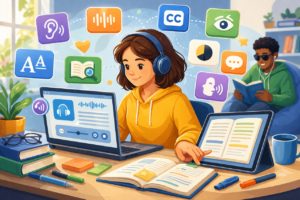
Accessibility tools also play an important role in confidence building. Many learners who struggle silently with reading, concentration, or comprehension may begin to doubt their own ability. When they are introduced to supportive tools that make learning more manageable, they often experience relief and renewed motivation. Being able to listen to a text, check the meaning of words instantly, or reduce the visual complexity of a screen can make the difference between abandoning a task and completing it successfully. Small improvements in access can therefore have a major impact on persistence, self-esteem, and willingness to continue learning.
Another important aspect of accessibility is that it supports learner autonomy. When young people know which tools help them most and how to use them independently, they become less dependent on constant external assistance. A learner who knows how to activate text-to-speech, use captions, enlarge text, or check vocabulary is better equipped to regulate their own learning and overcome difficulties without immediately giving up. In this way, accessibility tools are not only supports for inclusion, but also instruments for developing self-awareness and self-management within the Personal Learning Environment.
Examples of accessibility tools include text-to-speech readers, reading support extensions, dictionaries, vocabulary assistants, screen readers, captioning tools, speech-to-text options, translation supports, and interface adjustments. These tools can be integrated into everyday learning tasks, rather than being reserved only for specific situations. Their value increases when they are normalized as part of the learning environment, so that using support tools is seen as a legitimate and intelligent learning strategy rather than as a sign of weakness.
From a pedagogical perspective, it is important that accessibility tools are introduced in a supportive and non-stigmatizing way. Learners should be encouraged to explore which forms of support work best for them, and trainers should present these tools as standard options available to everyone. This helps create a more inclusive culture in which different learning needs are respected and where support is understood as part of good educational design. Accessibility should not be treated as an exception, but as a normal and expected feature of effective digital learning.
The educational value of accessibility tools therefore goes far beyond convenience. They make participation more equitable, reduce avoidable barriers, strengthen confidence, and support more personalized and sustainable learning pathways. Within the Personal Learning Environment, they help ensure that digital learning is not only available, but genuinely usable. For young NEETs, this can be decisive in creating an experience of learning that feels possible, respectful, and empowering.