
PLE Integration
A functional Personal Learning Environment is not created by collecting a large number of digital tools, but by selecting and combining a small number of resources with a clear and meaningful purpose. In the context of the FALLYNEETS project, the value of auxiliary digital tools lies not in their novelty or quantity, but in their ability to support learning in practical, coherent, and sustainable ways. A PLE should help learners gather information, organize tasks and resources, create outputs, communicate with others, and monitor their own progress. For this reason, it should be designed as a flexible but structured environment that is personal, useful, and easy to adapt over time.
For young NEETs, this principle is especially important. Many learners may feel discouraged when faced with too many digital platforms, overlapping applications, or unclear expectations. If the PLE becomes too complex, it can lose its educational value and become another source of confusion. A well-integrated PLE reduces this risk by focusing on a limited set of tools that each serve a distinct role. Instead of asking learners to navigate a fragmented digital ecosystem, it offers them a coherent framework in which each tool contributes to a specific part of the learning process.
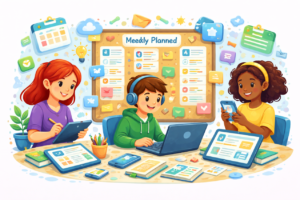
In this sense, PLE integration is closely linked to functionality. A tool is valuable not because it is popular or sophisticated, but because it performs a useful function within the learner’s routine. One tool may help with weekly planning, another with simplifying or understanding content, another with producing visual outputs, and another with
communication or feedback. What matters is that the tools work together in a logical way and respond to real learner needs. The aim is to create a digital environment that supports action, reflection, and continuity rather than distraction or overload.
Curating tools inside the PLE therefore means making intentional choices. Curation is not only about selecting digital tools, but also about deciding what should be included, what can be excluded, and how the learner will use each resource in practice. A young person may need one tool to plan weekly goals, another to manage notes, another to receive support from peers or mentors, and another to create a presentation or visual summary. The key idea is not quantity, but coherence. Each tool should serve a defined educational purpose and fit naturally into the learner’s workflow. This helps make the PLE more understandable, more manageable, and more meaningful.
Curation is also important because it supports personalization. No two learners will have exactly the same needs, preferences, or starting points. Some may benefit from visual planning tools, while others may rely more on audio support, note-taking apps, or simple communication spaces. A good PLE allows room for these differences while still maintaining overall clarity. Personalization does not mean using as many tools as possible, but choosing the right combination of supports for each learner. In this way, the PLE becomes an environment that reflects individual needs while still guiding learners toward common goals such as autonomy, participation, and employability.
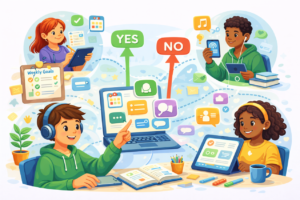
Another essential element of PLE integration is the development of a digital routine. A PLE becomes meaningful only when it is used consistently and with intention. Tools alone do not create learning habits; habits emerge when tools are integrated into repeated actions that learners can understand and sustain. For example, a learner may begin the week by checking a task board, continue by reading or simplifying a text, use a creative tool to produce a short output, communicate with a peer or mentor about progress, and end by
reflecting on what was learned. These repeated steps help learners experience digital learning as a process rather than as a disconnected series of activities.
Building a digital routine is particularly valuable for NEET learners who may have experienced discontinuity, lack of structure, or unstable learning habits. Routine provides predictability, and predictability reduces anxiety. When learners know where to begin, what to check, and how to move from one step to the next, they are more likely to stay engaged and less likely to feel lost. Even very simple routines, when repeated consistently, can strengthen self-management and create a greater sense of ownership over the learning process.
The routine dimension of the PLE also supports the gradual transition from guided learning to independent learning. At first, learners may need support in understanding when and how to use each tool. Over time, however, the goal is for them to internalize the process and make more autonomous decisions. A learner who regularly uses a planner, checks learning resources, creates outputs, and reflects on progress begins to develop not only digital habits, but also self-regulation skills. These include planning, monitoring, adjusting strategies, and maintaining focus over time. In this sense, the PLE is not simply a technical arrangement of apps, but a structure that supports the growth of learner autonomy.
It is also important to understand that a PLE combines both structure and mindset. Structurally, it includes a set of selected tools, resources, and routines that support learning. As a mindset, it encourages learners to see themselves as active agents who can shape their own learning pathways. This is particularly relevant for young NEETs, many of whom may not yet see themselves as confident or capable learners. A well-designed PLE can help change this perception by making progress visible, learning manageable, and support accessible. It creates a sense of control that is fundamental for rebuilding confidence and motivation.
In the FALLYNEETS context, the integration of auxiliary digital tools into the PLE is closely connected to employability and long-term development. The ability to select tools, organize tasks, communicate effectively, manage one’s own learning, and reflect on progress is valuable not only in education, but also in work and everyday life. By using the PLE in a practical and guided way, learners develop habits and competencies that can transfer to job searching, professional training, teamwork, and lifelong learning.
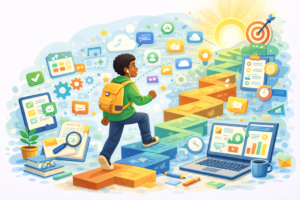
A well-designed PLE is therefore not only a technical environment, but also a practical pathway toward autonomy, confidence, and continuity. It helps learners move from fragmentation to coherence, from dependence to gradual independence, and from uncertainty to achievable progress. For young NEETs, this makes the PLE a powerful pedagogical framework: one that supports both immediate learning needs and the broader goal of becoming more active, self-aware, and capable participants in their own personal and professional development.