
Communication Tools
Communication tools help learners interact with peers, trainers, mentors, and wider support networks in meaningful and structured ways. Within the FALLYNEETS project, these tools are especially important because learning is not only an individual process, but also a social one. For many young NEETs, communication in learning environments can be difficult due to low confidence, limited participation in formal settings, or previous experiences of isolation or disengagement. Digital communication tools can help reduce these barriers by creating accessible spaces for exchange, feedback, collaboration, and support.
In a Personal Learning Environment, communication tools play a central role because they connect the learner with other people, resources, and opportunities. A learner may use them to ask questions, receive guidance, share progress, participate in group tasks, or reflect on ideas with others. This interaction strengthens the social dimension of learning and helps learners understand that they do not need to manage every challenge alone. In this sense, communication tools contribute not only to information exchange, but also to motivation, belonging, and confidence.
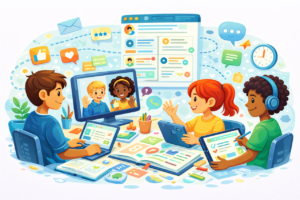
For young NEETs, these tools can be particularly valuable in overcoming feelings of isolation. Some learners may hesitate to speak in face-to-face environments, fear being judged, or feel unsure about how to express themselves in educational contexts. Digital communication spaces can offer a more flexible and less intimidating way to participate. Written comments, voice notes, chat functions, shared documents, discussion boards, or video calls may allow learners to contribute at their own pace and in ways that feel more manageable. This can increase participation and help learners gradually develop confidence in interaction.
Communication tools are also essential for collaboration. Many learning activities become more engaging and effective when learners can work together, exchange perspectives, and build something collectively. Collaboration platforms allow learners to co-create documents, comment on each other’s work, discuss ideas, divide responsibilities, and review shared progress. For NEET learners, this kind of structured collaboration can strengthen interpersonal skills, responsibility, and mutual support. It also helps them develop competencies that are directly relevant to employability, such as teamwork, communication, problem-solving, and respectful digital interaction.
Another important pedagogical value of communication tools lies in feedback. Learning becomes more meaningful when learners can receive timely responses to their work, questions, or doubts. Through digital communication platforms, trainers and peers can provide encouragement, corrections, suggestions, and recognition. This is particularly important for learners who need frequent reassurance or who benefit from step-by-step guidance. Constructive feedback can help learners stay engaged, understand mistakes as part of the process, and improve their work with greater confidence.
Communication tools also support the development of digital citizenship and responsible online behavior. Learners do not only need to know how to send messages or join online spaces; they also need to learn how to communicate clearly, respectfully, and safely in digital environments. This includes understanding tone, turn-taking, privacy, boundaries, and appropriate sharing of information. For NEET youth, these are valuable life and employability skills, since participation in training, work, and community life increasingly depends on the ability to communicate effectively online.
Examples of communication tools include messaging platforms, shared workspaces, collaborative documents, online forums, video meeting tools, discussion channels, and classroom communication applications. These tools may be used for one-to-one support, peer collaboration, group reflection, or project coordination. Their value lies not in the technology itself, but in how they create opportunities for learners to connect, ask for help, share ideas, and feel part of a learning process that is both personal and collective.
From a pedagogical perspective, communication tools should be introduced with clear purposes and simple routines. Learners should know why they are using a given platform,
what kind of communication is expected, and how participation will support their learning. Too many channels or unclear expectations can create confusion. For this reason, it is often more effective to use a small number of familiar tools consistently than to introduce many platforms at once. Clear guidance, supportive moderation, and simple collaborative tasks can help learners build confidence and use communication tools in meaningful ways.
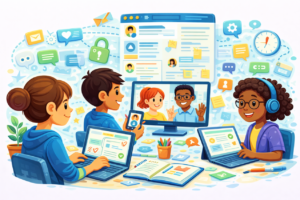
The educational value of communication tools therefore extends far beyond staying in contact. They help learners build social connection, develop collaboration skills, receive feedback, practise digital etiquette, and participate more actively in their own learning journeys. Within the Personal Learning Environment, communication tools strengthen the learner’s personal network and make learning more interactive, supportive, and socially grounded. For young NEETs, they can be a key bridge between individual effort and collective support, helping transform learning from an isolated activity into a shared and empowering experience.